Domain content-service.de kaufen?
Wir ziehen mit dem Projekt
content-service.de um.
Sind Sie am Kauf der Domain
content-service.de interessiert?
domain@kv-gmbh.de · 0541-91531010
Domain content-service.de kaufen?
Welche Wortart ist "freien"?
"Freien" kann sowohl ein Adjektiv als auch ein Verb sein. Als Adjektiv beschreibt es den Zustand von etwas, das nicht eingeschränkt oder gebunden ist. Als Verb kann es bedeuten, sich von etwas zu befreien oder jemanden zu befreien. **
Welche Wortart ist Zuhause?
Zuhause ist ein Substantiv, da es ein konkretes Ding oder einen konkreten Ort bezeichnet, an dem man lebt oder sich aufhält. Es kann auch als Adverb verwendet werden, um anzuzeigen, dass man sich an einem bestimmten Ort befindet oder hingehört. In manchen Fällen kann Zuhause auch als Pronomen verwendet werden, um auf den eigenen Wohnort oder den Ort, an dem man sich wohlfühlt, zu verweisen. Die genaue Wortart hängt also vom Kontext ab, in dem das Wort verwendet wird. **


Ähnliche Suchbegriffe für Wortart
Top-Angebote
Produkte zum Begriff Wortart:
-
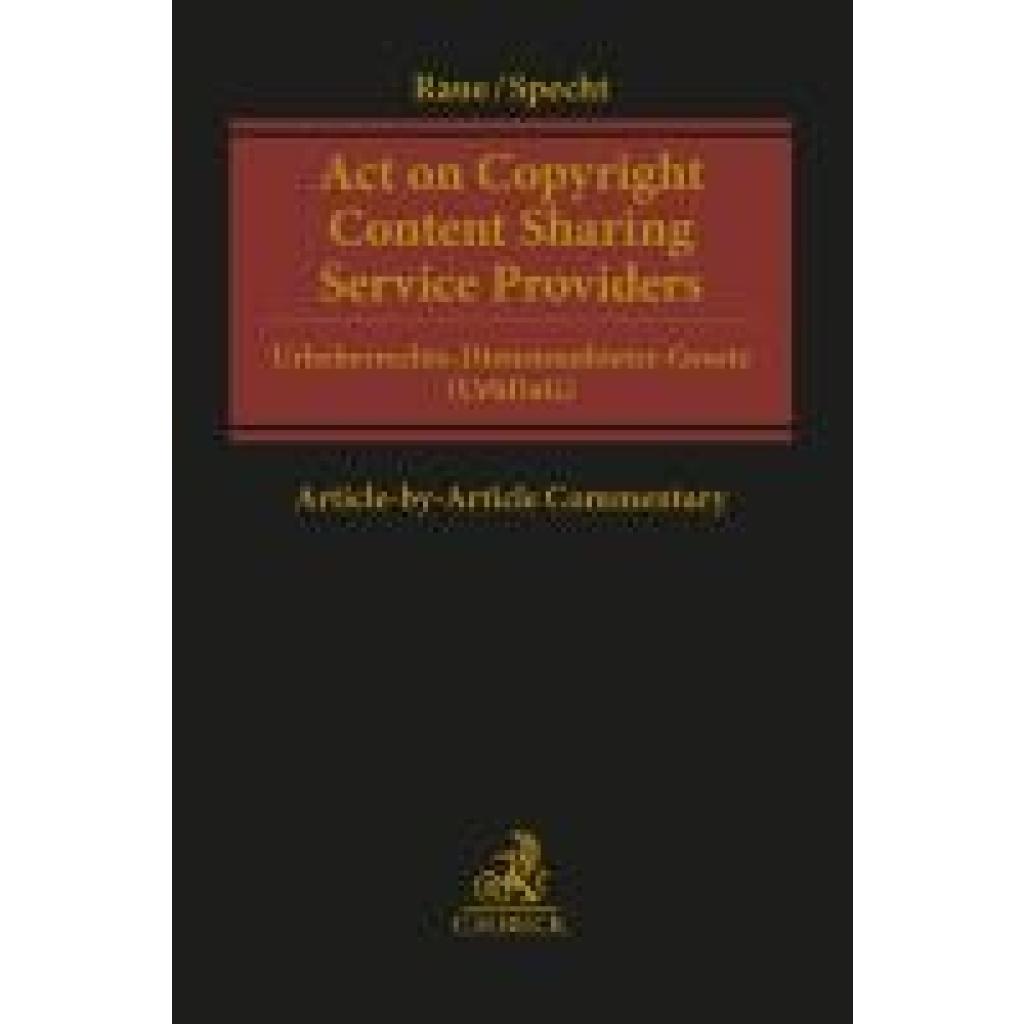
Raue, Benjamin: Act on Copyright Content Sharing Service ProvidersAct on Copyright Content Sharing Service Providers , The Book The Urheberrechts-Diensteanbieter-Gesetz (UrhDaG) is the German implementation of the controversial Art. 17 Directive 2019/790 (Copyright in the Digital Single Market, DSDM). Germany has decided against a minimum effort implementation and resisted the temptation to just incorporate the wording of the Directive more or less literally into the German Copyright Act (UrhG). Instead, it has opted for a comprehensive implementation in a stand-alone act, including: an extensive definition of an OCSSP with a safe-harbour clause for excluded service providers a detailed provision specifying the obligation to acquire contractual rights of use several provisions on direct remuneration for authors, performers and photographers very detailed provisions balancing between the obligation to preventively block copyright infringing material and the users' rights to freedom of expression and information which more or less anticipated (and likely influenced) the CJEU's decision Poland/Parliament and Council, including a section on uses presumably authorised by law a redress system consisting of complaints procedures and an alternative dispute resolution mechanism detailed obligations for measures against abuse rights of information for rightholders and for the purpose of scientific research The commentary of each article is headed by the current version of the article both in the German original and an English translation followed by a clearly and uniformly structured analysis of the provision including the extensive (academic) discussion that accompanied the implementation procedure. The interplay of the UrhDaG with the German Copyright Act is addressed as well as the respective requirements of the DSMD. The impact of the CJEU's first decision on Art. 17 DSDM (Poland/Parliament and Council) is discussed in the relevant provisions. As Art. 17 DSDM has been implemented very heterogeneously in the Member States, further decisions of the CJEU are to be expected. The detailed German implementation might serve as a reference and source of inspiration for the further specification of Art. 17 DSDM. The commentary aims to meet the expectations both of German and foreign lawyers interested in platform regulation and copyright by providing a detailed explanation both of the German implementation and, by that, of Art. 17 DSMD. The Advantages at a Glance Article-by-Article Commentary in English language clearly and uniformly structured analysis of each provision The Target Group For German and foreign Copyright lawyers. , Tagfahrleuchten > Beleuchtung , Auflage: 1. Auflage, Erscheinungsjahr: 20240527, Produktform: Kartoniert, Autoren: Raue, Benjamin~Specht-Riemenschneider, Louisa, Auflage: 24001, Auflage/Ausgabe: 1. Auflage, Seitenzahl/Blattzahl: 170, Keyword: Content Sharing; Copyright; Service Providers, Fachschema: Handelsrecht~Unternehmensrecht~Wettbewerbsrecht - Wettbewerbssache, Warengruppe: HC/Handels- und Wirtschaftsrecht, Arbeitsrecht, Fachkategorie: Gesellschafts-, Handels- und Wettbewerbsrecht, allgemein, UNSPSC: 49019900, Warenverzeichnis für die Außenhandelsstatistik: 49019900, Verlag: C.H. Beck, Verlag: C.H. Beck, Verlag: Verlag C.H. Beck oHG, Blätteranzahl: 184 Blätter, Länge: 239, Breite: 160, Höhe: 13, Gewicht: 368, Produktform: Kartoniert, Genre: Sozialwissenschaften/Recht/Wirtschaft, Genre: Sozialwissenschaften/Recht/Wirtschaft,90,00 €*Versand: 0,00 €Sichere Weiterleitung zum Anbieter



-
Welche Wortart ist "drei"?
"Drei" ist eine Zahlwortart, genauer gesagt eine Kardinalzahl. Es wird verwendet, um die Anzahl von Personen, Dingen oder Ereignissen auszudrücken. **
-
Welche Wortart ist "möchten"?
"Möchten" ist die Konjunktiv-II-Form des Verbs "mögen". Es wird verwendet, um höfliche oder indirekte Aufforderungen oder Wünsche auszudrücken. **
-
Welche Wortart ist "fast"?
"Fast" kann sowohl als Adjektiv als auch als Adverb verwendet werden. Als Adjektiv beschreibt es eine hohe Geschwindigkeit oder eine kurze Zeitspanne. Als Adverb gibt es an, dass etwas beinahe erreicht oder vollendet wurde. **
-
Welche Wortart ist "etwas"?
"etwas" ist ein Indefinitpronomen. Es wird verwendet, um eine unbestimmte Menge oder einen unbestimmten Grad auszudrücken. Es kann auch als Adverb verwendet werden, um eine geringe Menge oder einen geringen Grad auszudrücken. **


Welche Wortart ist dies?
Um diese Frage zu beantworten, müsste der konkrete Begriff genannt werden. Es gibt verschiedene Wortarten wie Substantive, Verben, Adjektive, Adverbien, Pronomen, Konjunktionen und Präpositionen. Jede Wortart hat ihre eigenen Merkmale und Funktionen in einem Satz. **
Was ist deine Wortart?
Ich bin ein KI-basierter Sprachassistent und habe keine Wortart, da ich keine Wörter besitze. Ich bin darauf programmiert, Fragen zu beantworten und Informationen bereitzustellen. **
Top-Angebote
Produkte zum Begriff Wortart:
-
Raue, Benjamin: Act on Copyright Content Sharing Service ProvidersAct on Copyright Content Sharing Service Providers , The Book The Urheberrechts-Diensteanbieter-Gesetz (UrhDaG) is the German implementation of the controversial Art. 17 Directive 2019/790 (Copyright in the Digital Single Market, DSDM). Germany has decided against a minimum effort implementation and resisted the temptation to just incorporate the wording of the Directive more or less literally into the German Copyright Act (UrhG). Instead, it has opted for a comprehensive implementation in a stand-alone act, including: an extensive definition of an OCSSP with a safe-harbour clause for excluded service providers a detailed provision specifying the obligation to acquire contractual rights of use several provisions on direct remuneration for authors, performers and photographers very detailed provisions balancing between the obligation to preventively block copyright infringing material and the users' rights to freedom of expression and information which more or less anticipated (and likely influenced) the CJEU's decision Poland/Parliament and Council, including a section on uses presumably authorised by law a redress system consisting of complaints procedures and an alternative dispute resolution mechanism detailed obligations for measures against abuse rights of information for rightholders and for the purpose of scientific research The commentary of each article is headed by the current version of the article both in the German original and an English translation followed by a clearly and uniformly structured analysis of the provision including the extensive (academic) discussion that accompanied the implementation procedure. The interplay of the UrhDaG with the German Copyright Act is addressed as well as the respective requirements of the DSMD. The impact of the CJEU's first decision on Art. 17 DSDM (Poland/Parliament and Council) is discussed in the relevant provisions. As Art. 17 DSDM has been implemented very heterogeneously in the Member States, further decisions of the CJEU are to be expected. The detailed German implementation might serve as a reference and source of inspiration for the further specification of Art. 17 DSDM. The commentary aims to meet the expectations both of German and foreign lawyers interested in platform regulation and copyright by providing a detailed explanation both of the German implementation and, by that, of Art. 17 DSMD. The Advantages at a Glance Article-by-Article Commentary in English language clearly and uniformly structured analysis of each provision The Target Group For German and foreign Copyright lawyers. , Tagfahrleuchten > Beleuchtung , Auflage: 1. Auflage, Erscheinungsjahr: 20240527, Produktform: Kartoniert, Autoren: Raue, Benjamin~Specht-Riemenschneider, Louisa, Auflage: 24001, Auflage/Ausgabe: 1. Auflage, Seitenzahl/Blattzahl: 170, Keyword: Content Sharing; Copyright; Service Providers, Fachschema: Handelsrecht~Unternehmensrecht~Wettbewerbsrecht - Wettbewerbssache, Warengruppe: HC/Handels- und Wirtschaftsrecht, Arbeitsrecht, Fachkategorie: Gesellschafts-, Handels- und Wettbewerbsrecht, allgemein, UNSPSC: 49019900, Warenverzeichnis für die Außenhandelsstatistik: 49019900, Verlag: C.H. Beck, Verlag: C.H. Beck, Verlag: Verlag C.H. Beck oHG, Blätteranzahl: 184 Blätter, Länge: 239, Breite: 160, Höhe: 13, Gewicht: 368, Produktform: Kartoniert, Genre: Sozialwissenschaften/Recht/Wirtschaft, Genre: Sozialwissenschaften/Recht/Wirtschaft,90,00 €*Versand: 0,00 €Sichere Weiterleitung zum Anbieter
-
Welche Wortart ist "freien"?
"Freien" kann sowohl ein Adjektiv als auch ein Verb sein. Als Adjektiv beschreibt es den Zustand von etwas, das nicht eingeschränkt oder gebunden ist. Als Verb kann es bedeuten, sich von etwas zu befreien oder jemanden zu befreien. **
-
Welche Wortart ist Zuhause?
Zuhause ist ein Substantiv, da es ein konkretes Ding oder einen konkreten Ort bezeichnet, an dem man lebt oder sich aufhält. Es kann auch als Adverb verwendet werden, um anzuzeigen, dass man sich an einem bestimmten Ort befindet oder hingehört. In manchen Fällen kann Zuhause auch als Pronomen verwendet werden, um auf den eigenen Wohnort oder den Ort, an dem man sich wohlfühlt, zu verweisen. Die genaue Wortart hängt also vom Kontext ab, in dem das Wort verwendet wird. **
-
Welche Wortart ist "drei"?
"Drei" ist eine Zahlwortart, genauer gesagt eine Kardinalzahl. Es wird verwendet, um die Anzahl von Personen, Dingen oder Ereignissen auszudrücken. **
-
Welche Wortart ist "möchten"?
"Möchten" ist die Konjunktiv-II-Form des Verbs "mögen". Es wird verwendet, um höfliche oder indirekte Aufforderungen oder Wünsche auszudrücken. **
Ähnliche Suchbegriffe für Wortart
-
Max Uthoff - Gegendarstellung: WortArt - Preis vom 28.09.2026 21:19:57 hBinding : Audio CD, Label : Random House Audio, Publisher : Random House Audio, NumberOfDiscs : 2, NumberOfItems : 2, Format : Audiobook, medium : Audio CD, publicationDate : 2015-05-11, runningTime : 150 minutes, authors : Max Uthoff, narrators : Max Uthoff, languages : german, ISBN : 38371308783,49 €*Versand: 0,00 €Sichere Weiterleitung zum Anbieter
-
Götz Frittrang - Wahnvorstellung: WortArt - Preis vom 28.09.2026 21:19:57 hBinding : Audio CD, Label : Random House Audio, Publisher : Random House Audio, Format : Audiobook, medium : Audio CD, publicationDate : 2013-03-04, runningTime : 70 minutes, authors : Götz Frittrang, narrators : Götz Frittrang, languages : german, ISBN : 38371202363,69 €*Versand: 0,00 €Sichere Weiterleitung zum Anbieter
-
Welche Wortart ist "fast"?
"Fast" kann sowohl als Adjektiv als auch als Adverb verwendet werden. Als Adjektiv beschreibt es eine hohe Geschwindigkeit oder eine kurze Zeitspanne. Als Adverb gibt es an, dass etwas beinahe erreicht oder vollendet wurde. **
-
Welche Wortart ist "etwas"?
"etwas" ist ein Indefinitpronomen. Es wird verwendet, um eine unbestimmte Menge oder einen unbestimmten Grad auszudrücken. Es kann auch als Adverb verwendet werden, um eine geringe Menge oder einen geringen Grad auszudrücken. **
-
Welche Wortart ist dies?
Um diese Frage zu beantworten, müsste der konkrete Begriff genannt werden. Es gibt verschiedene Wortarten wie Substantive, Verben, Adjektive, Adverbien, Pronomen, Konjunktionen und Präpositionen. Jede Wortart hat ihre eigenen Merkmale und Funktionen in einem Satz. **
-
Was ist deine Wortart?
Ich bin ein KI-basierter Sprachassistent und habe keine Wortart, da ich keine Wörter besitze. Ich bin darauf programmiert, Fragen zu beantworten und Informationen bereitzustellen. **
* Alle Preise verstehen sich inklusive der gesetzlichen Mehrwertsteuer und ggf. zuzüglich Versandkosten. Die Angebotsinformationen basieren auf den Angaben des jeweiligen Shops und werden über automatisierte Prozesse aktualisiert. Eine Aktualisierung in Echtzeit findet nicht statt, so dass es im Einzelfall zu Abweichungen kommen kann. ** Hinweis: Teile dieses Inhalts wurden von KI erstellt.